Best Accounting Software for Real Estate Businesses in 2026: 9 Proven Picks by Portfolio Size
Best accounting software for real estate businesses in 2026, compared by portfolio size, property-level reporting, and pricing for landlords and firms.

Best accounting software for real estate businesses is a search that means something different depending on who’s asking. A landlord with three rental units has completely different accounting needs than a property management company overseeing 500 units, and both look nothing like a real estate investment firm managing multiple LLCs and syndicated deals. Generic accounting software, the kind built for a typical small business, often falls short for all three because it wasn’t designed to track profit and loss by individual property, handle owner statements, or manage CAM reconciliation for commercial leases.
Real estate accounting has requirements most business bookkeeping software simply doesn’t anticipate: separate books per property or entity, rent roll tracking, Schedule E tax reporting for rental income, trust accounting for security deposits, and multi-entity consolidation when properties are held under different LLCs for liability protection. Trying to force a generic chart of accounts to handle all of that usually means hours of manual setup and reports you end up building in a spreadsheet anyway.
This guide breaks down the best accounting platforms for real estate in 2026, organized by the type of real estate business you actually run, individual landlords, professional property managers, and larger investment or development firms. Whether you’re managing a handful of rental units on the side or running a growing property management company, you’ll find a realistic fit here rather than a one-size-fits-all recommendation.
Why Real Estate Accounting Needs Specialized Software
Before comparing platforms, it’s worth understanding exactly what makes real estate accounting different from standard small business bookkeeping. Real estate businesses typically need:
- Property-level profit and loss statements — tracking income and expenses separately for each property rather than one combined bottom line
- Owner statements — for property managers reporting financial performance to property owners or investors
- Trust accounting — properly segregating security deposits and tenant funds from operating cash
- Schedule E reporting — tax reporting specific to rental real estate income for individual landlords
- CAM reconciliation — common area maintenance cost allocation for commercial leases
- Multi-entity consolidation — keeping separate books for each LLC while still seeing portfolio-wide performance
With those requirements in mind, here’s how the top accounting software for real estate businesses compares across different portfolio sizes and business types.
Best Accounting Software for Individual Landlords
1. Landlord Studio
Landlord Studio is built specifically for residential landlords and small portfolio investors, combining property-level accounting with practical field tools.
Key features:
- GPS mileage tracker and receipt scanner for on-the-go expense tracking
- Automated income tracking tied to individual properties
- Free tier available for up to three units
- Pro plan starting around $12/month, scaling with unit count
Best for: DIY landlords and small residential investors who want granular property-level insights without a steep learning curve.
2. Stessa (by Baselane)
Stessa offers genuinely free real estate accounting with automated income and expense tracking, making it one of the most accessible options for small landlords.


Key features:
- Free plan with automated bank feed syncing
- Portfolio dashboards showing performance across properties
- Tax-ready reports built around rental property needs
- Simple setup without requiring an accounting background
Best for: Small landlords who want free, automated property-level tracking without paying for features they won’t use.
3. REI Hub
REI Hub is purpose-built for rental property accounting, addressing the specific reports general accounting software leaves out, like net operating income and cash-on-cash return calculations.
Key features:
- Property-level chart of accounts built in from setup
- Net operating income and cash-on-cash reporting
- Integration with TurboTenant for combined accounting and tenant management
- Designed specifically to avoid the manual setup generic platforms require
Best for: Rental property owners who want reports tailored to real estate investing without customizing a generic accounting platform themselves.
Best Accounting Software for Property Management Companies
4. Buildium
Buildium is a comprehensive property management platform that pairs accounting with lease tracking, tenant screening, and maintenance coordination in one system.
Key features:
- Automatic 1099 generation for owners and vendors
- Digital lease signing and renewal tracking
- Tiered pricing: Essential starts around $62/month, Growth around $192/month, Premium around $400/month
- Reduced ACH fees and analytics tools at higher tiers
Best for: Property management companies overseeing residential portfolios that want accounting integrated with tenant and lease management.
5. AppFolio
AppFolio is built for larger, scaling property management operations that need a fully integrated property management and accounting platform across different property types.
Key features:
- Customizable plans for residential, community association, and commercial portfolios
- Automatic rent collection through a tenant portal
- Strong reporting and financial statement generation
- Extensive integrations across the property management workflow
Best for: Growing or large property management firms that need one platform handling both operations and accounting across diverse property types.
6. Yardi Breeze
Yardi Breeze targets small to mid-size property management businesses, automating routine tasks like leasing, rent collection, and maintenance management alongside core accounting.
Key features:
- Automated leasing and rent collection workflows
- Maintenance management tied to financial tracking
- Designed to simplify the transition from spreadsheets to structured accounting
- Scalable as portfolios grow from small to mid-size
Best for: Small to mid-size property management businesses that want an accessible entry point into Yardi’s broader property management ecosystem.
Best Accounting Software for Larger Real Estate Firms and Investors
7. QuickBooks Online (With a Property Layer)
QuickBooks Online remains a widely used starting point for real estate agents and small landlords, though it lacks native real estate-specific features like lease escalations and CAM reconciliation.
Key features:
- Affordable, familiar interface with a large accountant network
- Works well when paired with a dedicated property management layer or integration
- Broad third-party app ecosystem for connecting payment and reporting tools
- Suitable for early-stage real estate businesses before they outgrow it
Best for: Early-stage real estate businesses and agents who need general accounting now and plan to add specialized property tools as they scale.
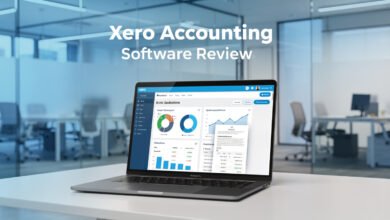
8. Xero
Xero works well as a backbone for property accounting, especially when paired with two-way integrations like Re-Leased, giving small to mid-sized real estate operations a capable, affordable system.
Key features:
- Unlimited users on every plan, useful for growing real estate teams
- Two-way integrations with dedicated property management platforms
- Clean interface that’s quick for teams modernizing from spreadsheets
- Strong bank reconciliation and multi-currency support for international property investors
Best for: Small to mid-sized real estate operations that want a capable general ledger paired with a specialized property management integration.
9. Sage Intacct
Sage Intacct serves real estate investors and multi-entity operators that need dimensional and fund reporting beyond what general accounting software or basic property management tools provide.
Key features:
- Multi-entity consolidation for portfolios held across multiple LLCs
- Dimensional reporting by property, fund, or business segment
- Strong audit trail and compliance support for investor reporting
- Scales toward the complexity larger investment firms and developers need
Best for: Real estate investment firms and multi-entity operators that need fund-level reporting and consolidation across numerous properties or LLCs.
Choosing Accounting Software Based on Your Real Estate Business Type
Since real estate businesses vary so widely, here’s a practical way to narrow the decision:
- Individual landlords with a handful of units: Stessa or Landlord Studio, both offering free tiers with property-level tracking
- Growing landlords needing deeper reporting: REI Hub, built specifically around investor-focused metrics
- Small to mid-size property management companies: Buildium or Yardi Breeze, combining accounting with tenant and lease management
- Larger property management firms: AppFolio, for portfolios needing a fully integrated operations and accounting platform
- Real estate agents or early-stage businesses: QuickBooks Online, paired with a property management integration as needed
- Multi-entity investors and syndicators: Sage Intacct, for dimensional reporting and fund-level consolidation
For a deeper comparison of real estate accounting platforms by portfolio complexity, this real estate accounting software guide breaks down options from small landlords through full ERP deployments. If you’re specifically weighing rental property platforms against general accounting software, this rental property accounting software comparison covers pricing and feature differences across several tools in more detail.
Conclusion
The best accounting software for real estate businesses depends heavily on where your portfolio sits today and where it’s headed. Individual landlords with a small number of units do well starting with free or low-cost tools like Stessa, Landlord Studio, or REI Hub, all built specifically around property-level tracking and rental tax reporting. Property management companies benefit more from platforms like Buildium, AppFolio, or Yardi Breeze that combine accounting with lease and tenant management in one system. Larger investment firms and multi-entity operators generally need the dimensional reporting power of Sage Intacct, while QuickBooks Online or Xero remain reasonable starting points for early-stage real estate businesses before their accounting needs grow more specialized. Rather than defaulting to whichever accounting software is most familiar, match the platform to your portfolio size and the specific reports your real estate business actually needs to run well.